|
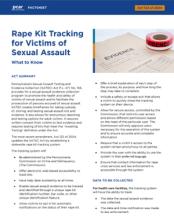
Screening Patients for Sexual Violence
This CD tutorial program and implementation guide are perfect tools
to help you effectively prepare your local healthcare providers to
screen for sexual violence.
Download
the implementation guide - (PDF - 156K)
Download the contents of
the accompanying CD (ZIP - 322Megs)
Reaching Latino Victims of Sexual Violence: A Marketing Toolkit
The Sexual
Assault Resource Counseling Center (SARCC) of Lebanon County,
PA developed this toolkit for its Latino public awareness and outreach
campaign. It provides an overview of the research that informed
SARCC's approach, the five radio spots that were developed, including
their scripts, and tips for adapting this campaign throughout
the Commonwealth's communities. Download the booklet (PDF - 238K)
Download radio spots:
It Can Happen to You - English - Spanish (MP3
- 2Megs)
Ready to Listen - Spanish (MP3
- 931K)
Someone I Love - Spanish (MP3
- 925K)
The Right Thing - English (MP3
- 976K)
Healthcare Response
to Sexual Violence: Implementation Guide
While research shows
that sexual violence can be the root of many health care complications
and disease, many victims/survivors of sexual violence revolve
in and out of healthcare settings for years without ever being
asked about their victimization. This guide is a tool to help
train healthcare providers in screening for and responding
to sexual violence.
Download
the booklet (PDF
- 166K)
Download
contents of accompanying CD (ZIP - 21Megs)
The Pennsylvania Sexual Violence Benchbook.
The Pennsylvania Sexual Violence Benchbook provides a comprehensive
understanding of Pennsylvania’s
current sexual offense laws. Section one, Understanding Sexual
Violence, highlights the impact of sexual violence
on a victim. Section two, The Process of a Sex Offense Case, addresses
the procedural and practical steps of a sex offense case. Section
three, Life After Megan’s Law, reviews and compares collateral
ramifications of a sexual offense conviction, including sex offender
registration laws.
Section four, Resources, provides a list of victims’ service providers
as well as current research. While this book is written primarily
as a resource for Pennsylvania Judges, others in the criminal justice
system
may find it ’s
contents helpful.
Poverty
and Sexual Violence: Building Prevention and Intervention Responses.
There is a complex and often reciprocal relationship between poverty
and sexual violence. This guide is intended to support rape crisis
centers in their economic advocacy efforts at all levels of the
organization, using the Spectrum of Violence Prevention as a blueprint
in responding
to the needs of victims, survivors, and communities.
Meeting
the Needs of Prison Rape Victims: A Technical Assistance
Guide for Sexual Assault Counselors and Advocates Victims
of prison rape are largely underserved. This guide is intended
to support rape crisis counselors and advocates in providing services
to victims
of prison rape. To that end, the guide includes an overview of
the problem of prison rape, outreach strategies, ethical discussions,
and things
to keep in mind when working in a prison setting.
Sexual
Assault /Victims Compensation Assistance Program Manual The
manual provides a review of VCAP and helps guide counselor/advocates
in coupling VCAP with sexual assault victims and their families.
It is based on core believes about compensation and how it is
related to victimization
and healing. Forms for this document have been removed but may be found
at www.pccd.state.pa.us.
Parameters
of Privilege and Confidentiality when Collaborating
with Community Partners:
A Guide for Sexual Assault
Counselors and Advocates This
technical assistance guide is intended to support sexual violence
advocates in their community-based collaborations. The guide includes
information
on the sexual assault counselor/advocate--client privilege statute
in PA, the "dos and don'ts" of confidentiality, as well as
strategies for preventing conflicts and misunderstandings when collaborating
with
multidisciplinary partners.
"Put
Down the Chart, Pick Up the Questions, a guide
to working with survivors of sexual violence” is
a tool for healthcare providers to screen patients for sexual
assault histories. This book, which adapts
the SAVE method from the Florida Council Against Sexual Violence,
includes special considerations for immediate victims, comorbid
conditions, pregnancy/gynecological
care, patients with disabilities, males, adolescents and children.
SAVE card
Screening booklet
“Providing
a VIctim-Centered Response to the Problems of Child Sexual
Abuse by the Clergy,” is
a document intended to aid sexual violence advocates in their
advocacy efforts around sexual abuse in the clergy. With the
ultimate goals
being to prevent future sexual abuse and to advocate on behalf
of existing survivors, this document includes 11 recommendations
to influence church
policy. For more information, please contact the Pennsylvania
Coalition Against Rape at 800-692-7445 or the National Sexual
Violence Resource
Center at 877-739-3895.
"A Tool for Recovery," a toolkit
designed to aid Sexual Assault Counselors and Advocates in introducing
the topic of Crime Victims Compensation
to sexual assault victims as part of their healing process is now
available for download. More information . . .
Technical Assistance Bulletins
STOP Newsletter
- Fall
2003 - What Is the Pennsylvania Coalition Against Rape / Pennsylvania
Coalition Against Sexual Violence
- Winter
2003 - Evidence-based Prosecution and Surviving Domestic Violence
- Summer
2004 - Sex Trafficking in the United States
- Fall
2004 - What Is Stalking
- Winter
2005 - So How Many Rapes Are False?
- Spring
2005 - Elder Sexual Abuse: The Dynamics of the Problem
and Community-based Solutions
- Fall
2005 -
Sexual Violence Against Individuals with Disabilities
- Spring
2006 -
Address Confidentiality Program
- Summer
2006 - Governor
Signs Act 78 of 2006
- Spring
2007 - Tips for
Testifying as an Expert Witness in a Violence Against Women Prosecution
- Fall
2007 - The Role of
University Judicial Boards of Review
in College Campus Sexual Assault:
What Advocates and Police Need to Know
|